


Contents
I. AI real estate videos: Does the output actually hold up?
1. The business case: What the numbers actually say
II. How AI property videos actually work
1. Popular tools for creating real estate videos with AI
III. AI videos for real estate: The legal landscape
IV. Creating real estate videos with AI: DIY vs. working with professionals
V. Summing it up
The real estate industry has always sold a vision before selling a home. Today, AI real estate videos are reshaping how that vision reaches buyers, reducing production timelines from days to minutes and lowering costs from thousands of dollars to around $2-$50 per listing (for DIY AI video platforms). However, as the tools multiply and the promises become louder, one question arises among agents and brokers: does the output hold up well enough to publish under your name, or does it simply shift the work to cleanup and review before anything goes live? Here is a practical answer from our AI video agency.
AI real estate videos: Does the output actually hold up?
The short answer is: it depends entirely on how the work is done. A listing teaser generated in five minutes by a photo-to-video app and a cinematic property showcase created by a professional AI video production company may both be described as AI real estate videos, but they occupy entirely different positions on the quality spectrum. Understanding that gap — and knowing when each approach makes the most sense — is what separates agencies that consistently win new listings from those simply trying to keep pace with the wider real estate field.
AI-generated property video has moved from novelty to mainstream marketing tool with remarkable speed. A quick Google Trends search shows that the search term “AI real estate video” grew 425% year-over-year since 2024. The NAR 2025 Technology Survey — conducted last summer across a random sample of 49,233 active Realtors — found that 46% of respondents already use AI-generated content, with 20% engaging AI tools daily and 22% doing so weekly. The adoption is structural, not temporary, and it is continuing to accelerate across all market segments.
Despite that rapid adoption, video marketing in real estate remains surprisingly underdeveloped overall. NAR data shows only about a quarter of agents consistently use video on every listing, and just 9% create listing-specific videos. That gap exists largely because traditional property video production is expensive — standard walkthroughs may cost $300-$800, drone footage adds $600-$1,500, and luxury cinematic packages often exceed $5,000. AI-generated property videos lower the cost barrier and almost completely eliminate scheduling friction, opening up a new marketing channel for agencies on a tight budget.

Source: Nano Banana
The business case: What the numbers actually say
The performance case for real estate video is well established, and the supporting data grows stronger with each year. Zillow’s own numbers make the point clear: Showcase — its AI-powered immersive experience combining interactive floor plans and virtual staging — drives 79% more page views, 76% more saves, and 91% more shares versus similar nearby non-Showcase properties on the platform. Agents who use Showcase on the majority of their listings win 30% more new clients and see homes sell for approximately 2% more on average than comparable properties.
Compass offers a useful performance benchmark at the brokerage level. The firm’s AI-powered Video Studio, launched in 2021, allows agents to generate professional listing videos from photos in minutes, without a production crew. By Q4 2025, Compass reported record revenue of $1.70B — up 23.1% year-over-year — while organic transactions grew 5.6% in a market that expanded just 0.7% over the same period. The platform hit a Q4 record of 20 average weekly sessions per agent, a clear sign of genuine adoption at real operational scale across the network.
Buyer behavior has also shifted toward video-first property discovery. Most property searches now begin on mobile, and short-form video has trained buyers to expect cinematic, information-rich content within the first few seconds of engagement. A static gallery of photos against which a listing competes with video-enhanced entries is at a structural disadvantage on most major platforms, from Zillow and Rightmove to Instagram and YouTube. That behavioral shift is not reversing; rather, it is deepening with each platform algorithm update, and AI real estate videos remain at the forefront of the revolution.
How AI property videos actually work
For everyday social media and listing content, AI-generated real estate videos genuinely deliver on their core promise. Photo-to-video tools such as VibePeak, Tour Estate AI, and Reel-E can turn a full set of MLS listing photos into a finished reel in two to five minutes — camera motion, music, captions, branded overlays, and vertical formats for Reels, Shorts, and TikTok all naturally included. The marginal cost per video — often between $1–$20 — makes it practical for real estate agencies to produce video content for every listing in a portfolio, not just the high-value flagship properties.
A standard AI listing video workflow looks roughly like this: you upload MLS photos, let the platform generate depth maps and apply Ken Burns or dolly camera motion, add price and bed/bath overlays, attach a music track and optional voiceover, and then export in the required aspect ratios for each distribution channel. Total production time: under five minutes per listing. For real estate agencies processing dozens of listings each week, batch tools allow an entire portfolio to be turned around in a single session — no traditional production crew can match that pace.
Popular tools for creating real estate videos with AI
The generative video ecosystem has matured considerably since 2022, and understanding which tools do what is now a practical business decision for any agency seriously investing in AI real estate video content. The artificial intelligence platforms most commonly used in professional property video production fall into three distinct categories, each sitting at a different point on the quality and control spectrum — from fast, high-volume social content all the way to frame-level cinematic production that requires genuine expert creative direction and oversight.

Source: Nano Banana
- Photo-to-video tools built specifically for real estate include VibePeak, Tour Estate AI, Reel-E, and AutoReel. These platforms handle the full listing teaser pipeline automatically — depth-based camera motion, music, overlays, aspect ratio exports, and optional voiceover in multiple languages. They are optimized for speed and volume, not for creative control or premium visual output. Pricing typically runs $1–$50 per video, or $13–$129 per month for subscription access, with batch processing, multi-format export, and branded templates all included as standard features.
- Generative video models for cinematic production, including Seedance 2.0, Runway Gen-4.5, Google Veo 3, and Kling 3.0. They give creative directors frame-level control over camera moves, lighting, motion brushing, and reference consistency across scenes. Runway excels at storyboard-driven B-roll and precise virtual camera arcs. Veo 3 delivers up to 4K output with synchronized audio. Kling 3.0 handles longer continuous clips particularly well. These are the tools behind professional AI video production, not self-service listing teasers aimed at speed and low cost.
- Editing and distribution tools, such as CapCut, Descript, VEED, and DaVinci Resolve. Even the best AI-generated clips need assembly, rhythm, and deliberate pacing before they are ready to publish. DaVinci Resolve handles complex multi-clip timelines and professional color grading with precision. CapCut is the most practical mobile-first option for agents cutting reels between appointments, though its ByteDance ownership raises data and security compliance concerns for some US brokerages and larger agency networks operating under strict IT governance policies.
The tool category you choose determines not just the output quality but also the total cost of production — and the gap between tiers is considerably wider than most agencies initially expect. With a DIY photo-to-video app, you can create a 30-second listing reel for as little as $25 in platform fees. The cost of a professionally produced 30-second AI video from a reputable agency, by contrast, starts at around $2,000, with per-minute rates running $4,000+ depending on complexity, realism, number of characters, and whether hybrid elements such as drone footage are involved.
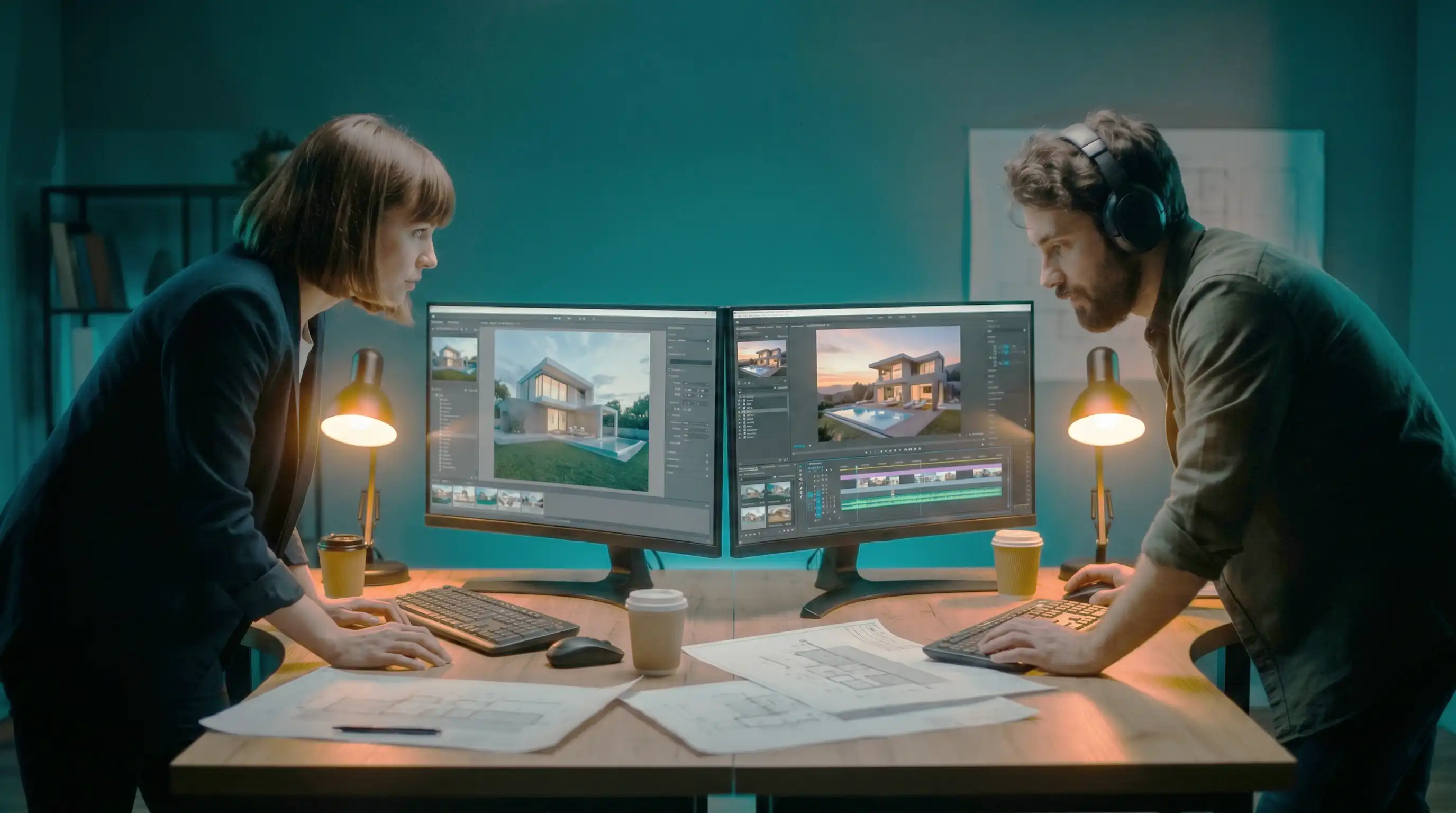
That price difference reflects genuine production labor. Cinematic AI video requires a skilled prompt engineer, a creative director, and a video editor working in close collaboration, often generating dozens of clips to yield 30 usable seconds. For luxury properties or developments that exist only on paper, that level of investment is not a luxury itself. Generic-looking AI property videos do not sell a $5M penthouse or a pre-construction residential tower. Buyers at that tier expect production values that match the price of the asset they are considering, and collaborating with experts is the only way to achieve this.
Source: Nano Banana
AI videos for real estate: The legal landscape
Legal exposure is the dimension most agencies underestimate when first adopting artificial intelligence for real estate property video. California’s Assembly Bill 723 — effective January 1, 2026 — requires licensees to conspicuously disclose when listing visuals have been digitally altered and to provide access to the original, unaltered version. The law covers every marketing channel real estate agents typically use: MLS listings, brokerage websites, social media, email campaigns, and print materials. Willful violations are treated as misdemeanors under California’s real estate licensing law.
The EU AI Act extends comparable obligations across Western Europe. Article 50(4) requires deployers of artificial intelligence systems that generate or manipulate visual content constituting a deepfake to disclose that the content has been artificially generated (obligations applying from August 2, 2026). Penalties for transparency breaches can reach up to €15 million or 3% of worldwide annual turnover. UK consumer law under the Digital Markets, Competition and Consumers Act 2024 treats the omission of material information as an automatic unfair commercial practice.
These frameworks share a consistent logic: cosmetic edits that do not change a buyer’s understanding of the property — think lighting correction, white balance, cropping, and exposure adjustment — are generally permissible without disclosure. Edits that add, remove, or change physical features like virtual furniture, resized windows, replaced surfaces, or removed power lines require clear labeling and access to the original image. The safest approach, and the one that builds genuine buyer trust, is to label every AI-processed asset and retain all originals on file.
The reputational risk of undisclosed AI manipulation is no longer theoretical. A WIRED investigation in October 2025 documented a Michigan listing where AI-altered photos showed missing kitchen cabinets, a concrete patio replaced by a green lawn, and dramatically resized windows, drawing over 1,000 comments on Reddit. The same report highlighted a Franklin, Tennessee walkthrough video that was entirely generated using artificial intelligence: luxury furniture, a wine cellar, and a soaking tub that did not exist, all narrated by an AI avatar agent over a simulated camera pan.
The incidents have continued into 2026. In February, a Washington, D.C. rental on Apartments.com went viral after AI photo editing left a distorted humanoid figure emerging from a bathroom mirror; the listing was quickly pulled, but screenshots had already spread widely across Reddit and social media. A separate New York StreetEasy listing used an AI-generated image to make a small loft appear significantly larger than it was. In each case, the reputational damage to the agent involved was immediate, public, and far disproportionate to the original shortcut.

Source: Nano Banana
Creating real estate videos with AI: DIY vs. working with professionals
DIY AI video tools have a clear and legitimate place in real estate marketing. For mid-market listings, rental properties, and high-volume social content, self-service platforms such as VibePeak, Tour Estate AI, and AutoReel deliver real value: a finished reel in minutes, predictable subscription costs, and no dependency on an external production team. This tier of artificial intelligence platforms genuinely serves agents who need to produce video content across dozens of listings each month and whose brand does not depend on premium production values.
At the premium end, however, DIY AI real estate videos quickly show their limitations. Pre-configured platforms are built around templates, automated camera motion, and batch processing — approaches that deliver consistent output at volume but cannot ensure the controlled lighting, deliberate shot sequencing, or narrative arc that a luxury property demands. A self-service tool will apply the same slow zoom to a $4M penthouse that it applies to a $350,000 suburban home. This visual sameness not only underperforms but also actively diminishes the perceived value of a luxury property.
Off-plan developments present a separate challenge that no DIY tool can address. For a residential tower still under construction or a spa resort at the planning stage, generative AI with professional direction creates a compelling, photorealistic visual before anything is built — something no camera crew can do. AI real estate videos also cost a fraction of a traditional 3D architectural walkthrough, which typically runs $2,000–$15,000 for a 30–60 second animation produced in software like 3ds Max or Cinema 4D, while delivering comparable or superior visual quality.
Working with a professional AI video production agency changes what is possible at every property category. Studio-grade models — Runway, Veo-3, and Kling 3.0 — give creative directors frame-level control over camera moves, lighting, and visual consistency that no subscription tool can replicate. That precision matters for luxury listings, where generic output undermines perceived value, and for off-plan projects, where photorealistic renders of unbuilt spaces are the primary marketing asset. A professional AI video production team also reviews every frame before publication.
Premium AI video production for real estate — not templates, not subscriptions, not automated pipelines — is what YOPRST specializes in. As an AI video production agency working with property developers, luxury brokerages, and real estate brands across the US and Western Europe, YOPRST pairs studio-grade Gen AI models with professional creative direction, editorial discipline, and deep platform expertise. The result is an AI real estate video that matches the tier of the asset, holds up under legal scrutiny, and looks nothing like output from a self-service tool.
Summing it up
AI real estate videos have moved past the hype phase and into operational reality. The technology is capable enough to produce compelling marketing content for the vast majority of listings — and affordable enough that there is no longer a reasonable argument for skipping video on any property. If you are working out how to make real estate videos with AI, the honest answer is: it depends on what the property needs. A DIY tool is the best choice for high-volume social content. A professionally produced artificial intelligence video is the right call for everything else.
Our team specializes in the premium end of AI real estate video production, creating cinematic content for luxury brokerages, property developers, and off-plan projects. If you have a premium development project to launch, a flagship property to market, or a real estate portfolio that requires far more than a subscription AI platform can provide, we’d like to hear about it. Contact YOPRST to discuss your next project and learn how professionally directed artificial intelligence videos can benefit your property, brand, and sales pipeline. We take on a limited number of projects each quarter to protect quality.